Conceptual Product Design
UI screens that turn invisible UPI spends into calm, controlled decisions - reducing financial anxiety while driving higher engagement and revenue.
Project Overview
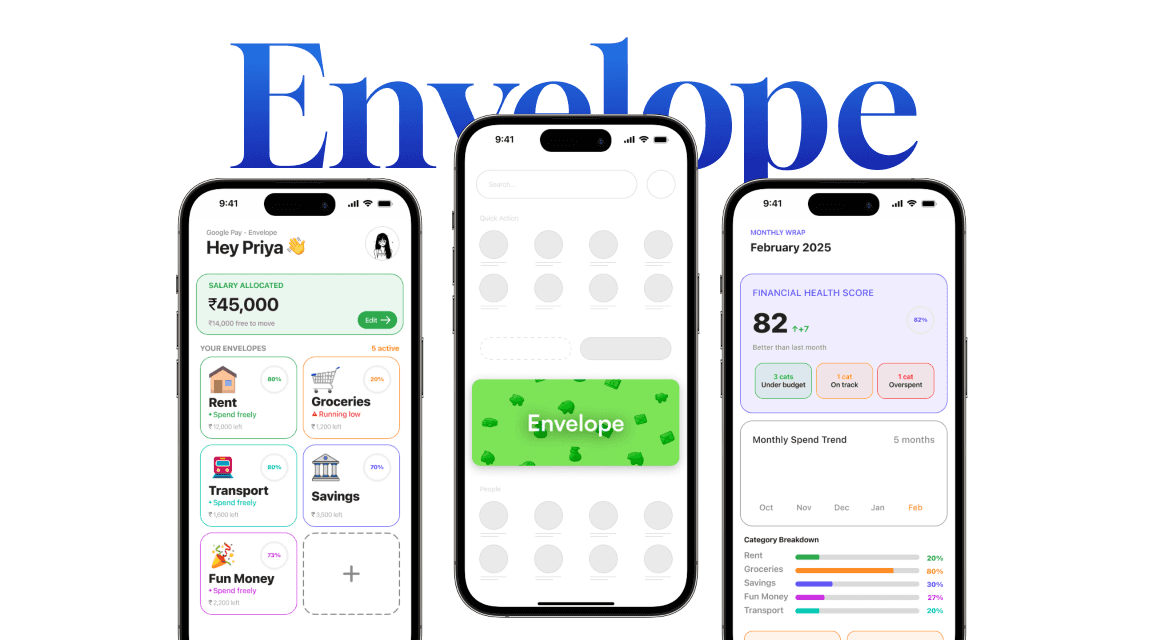
Envelopes is a conceptual UI feature for Google Pay that translates the century-old envelope budgeting method into a native digital experience for UPI users in India. Instead of one flat balance, your money lives in named, visual envelopes - Rent, Groceries, Savings, Fun Money. Each envelope fills when your salary arrives and depletes as you spend, so you always know exactly where your money stands, category by category.
Role
Type
Duration Platform
UX/UI & Product Design
Conceptual Redesign
1 Month
Android / iOS
02
Problem Statement
UPI's single-balance view gives users no context around their spending — leading to impulsive transactions, budget confusion, and growing financial anxiety among young Indians.
No category separation - users can't tell spendable money from reserved funds
Savings feel invisible - no milestone, no progress bar, no motivation
Impulse spending goes unchecked - essentials and luxuries compete for the same balance
End-of-month panic is common - money disappears without explanation
UPI eliminates the "pain of paying" - frictionless = financially dangerous
The core issue wasn't just spending, it was invisibility.
21.7B
UPI transactions in Jan 2026 · NPCI
75%
UPI users report increased spending vs cash · IIIT-Delhi
55%
Indian Gen Z live paycheck-to-paycheck · Deloitte 2025
59.8% admitted overspending due to reduced digital payment friction
Financial stress ranked #1 anxiety source for Gen Z in India
Competitors like YNAB, Jupiter & Walnut all exist outside the payment moment
Google Pay has the trust and infrastructure — but no budgeting layer
Volume growth ≠ financial wellbeing.
(07)
(Hi-fi Design)
© 2026
The Design
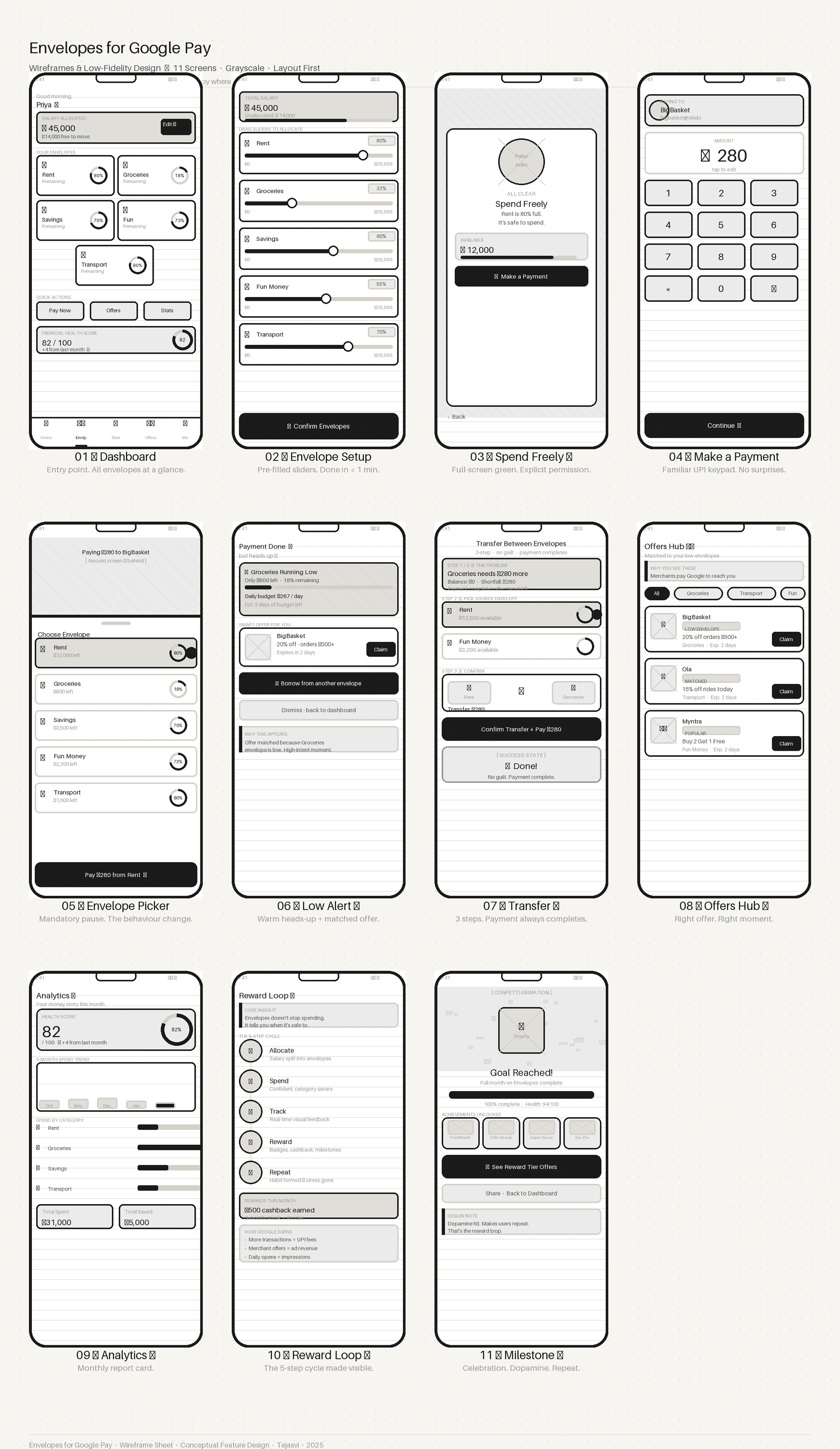
Every screen in Envelopes was designed as part of a connected system - not a collection of isolated UI. Each decision point feeds the next: salary allocation sets the envelope limits, the envelope limits power the picker, the picker feeds the health score, and the health score unlocks the reward loop. No screen works in isolation. Every colour, every ring, every mandatory pause exists because something earlier in the flow made it necessary - and something later in the flow depends on it.
Experience Validation
Users who can see exactly where their money is going spend more confidently - and more frequently. The Spend Freely screen alone removes the single biggest blocker to discretionary spending: the fear of overspending. When users feel safe, they tap Pay Now. Every tap is a transaction. Every transaction is a fee.
Business Validation
The Offers Hub appears precisely when an envelope is low - the highest-intent shopping moment that exists. A user who just saw "Groceries: ₹800 left" and then sees a 20% off BigBasket deal is not being interrupted. They are being helped. Merchants pay premium rates for that moment. That is the business model.
Revenue Streams
Three ways Envelopes earns:
· Transaction fees : more confident spending = more UPI payments = more fee income for Google Pay.
· Merchant advertising : brands pay to appear inside low-envelope moments. Not random ads. Targeted, timed, contextual.
· Daily active use : the Health Score and Analytics give users a reason to open the app every day, not just when paying. More sessions = more impressions = more ad value.
Is it valid?
Yes. The model works because it aligns incentives. Users want to spend confidently. Merchants want high-intent customers. Google wants daily active users. Envelopes delivers all three from the same set of screens - and it does it transparently, which is why users trust it enough to keep coming back.
Outcome
The Envelopes system ran end-to-end with zero redundant screens - every tap leads somewhere intentional, every flow completes without friction. The mandatory envelope picker, which looked like added friction on paper, became the most valuable interaction in the prototype - the one pause that makes every other screen meaningful.
The guilt-free transfer flow solved the single biggest emotional problem in budgeting apps: the moment a payment fails because of a self-imposed limit. By never blocking a payment, just redirecting it consciously, the design turned a potential drop-off into a moment of empowerment.
Key Learnings
Anxiety is a design problem, not a user problem. Users weren't bad at managing money - they just had no information at the right moment. Give people clarity and they make better decisions automatically. The green Spend Freely screen proved this in one interaction.
The smallest interventions carry the most weight. The envelope picker is two seconds of friction. It changes behaviour permanently. Good UX is not always about removing steps - sometimes it's about adding exactly one intentional pause at exactly the right moment.