
UX Case Study / Product Thinking
Designing transparency to help users assess AI reliability
Context
As AI-generated responses are increasingly used for critical decisions, users struggle to judge their reliability. Current interfaces present answers with high confidence but offer little visibility into uncertainty, reasoning quality, or source credibility. This lack of transparency makes it difficult for users to know when to trust, verify, or question AI outputs—especially in high-risk or regulated scenarios.
Core Problem
AI systems communicate answers clearly, but not their confidence, limits, or reliability. Without visible trust signals, users either over-trust incorrect outputs or hesitate to rely on AI at all.
Key Insights
Users trust AI more when uncertainty is visible
Confidence without explanation reduces credibility
Transparency supports informed judgment, not blind trust
Design Strategy
Make AI reliability and uncertainty visible at the point of interaction
Support user judgment, not passive consumption of answers
Communicate trust through signals, context, and explanations, not warnings
Maintain a calm, non-disruptive experience while surfacing critical information
Solution
A transparency layer that helps users evaluate AI-generated responses
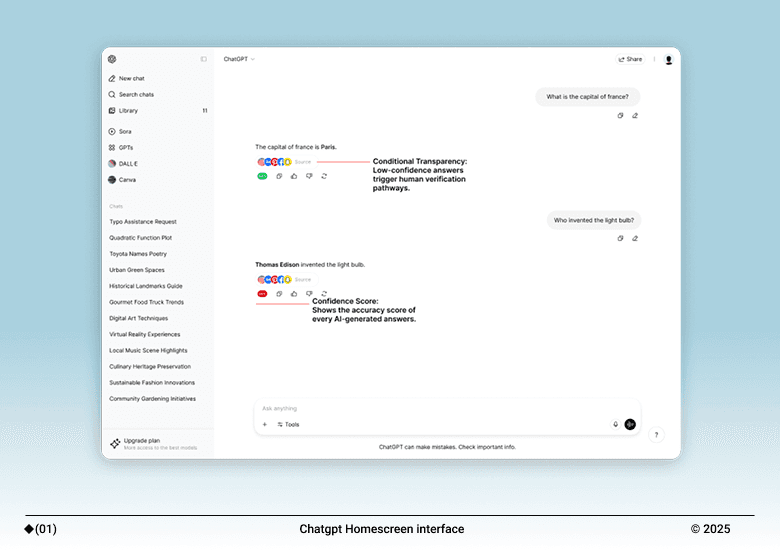
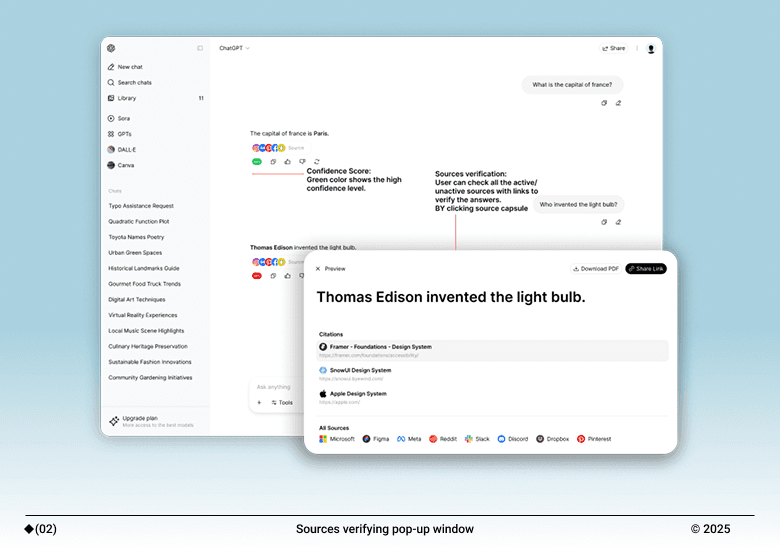
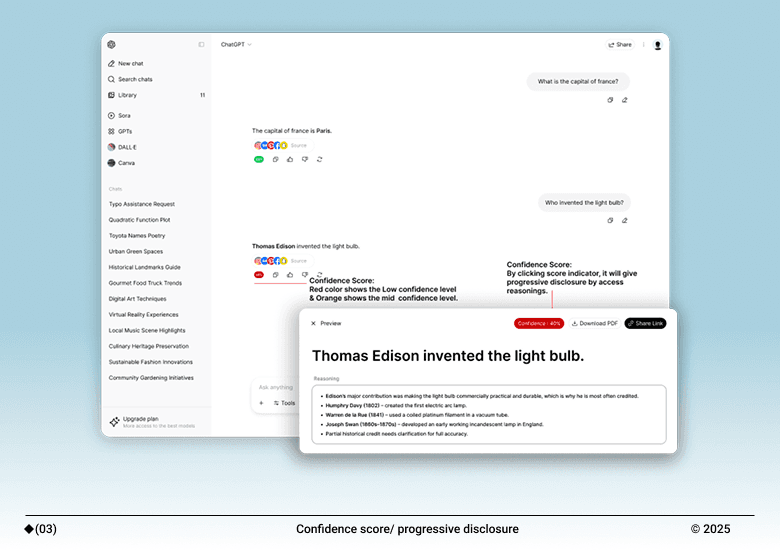
Surfaces confidence indicators, reasoning context, and source reliability
Provides trust signals without interrupting the primary workflow
Encourages users to verify, question, and contextualize AI outputs
002
Key Screens
To reach the final interface design, the project went through critical UX stages including competitive analysis of existing AI tools, identification of trust breakdown patterns, definition of user pain points, user flow mapping, information architecture, and low-fidelity exploration. These steps ensured that transparency features were grounded in real user needs rather than surface-level UI additions.
The final screens reflect this process through clear visual indicators, structured layouts, and consistent interaction patterns. Trust signals are integrated seamlessly into the interface, allowing users to evaluate AI responses without interrupting their workflow, while maintaining clarity, predictability, and control.
(03)
(Outcome & Learnings)
© 2025
Outcome
Improved user ability to evaluate AI reliability
Reduced blind trust and increased critical engagement
Stronger confidence in using AI for high-stakes decisions
Key Learning
Trust is built through transparency, not confidence
Users value AI that acknowledges uncertainty
Designing for judgment is essential in high-risk AI systems