In 2025, as AI systems became integral to business decision-making, a critical trust crisis emerged. The "confidence paradox" – where AI presents false information with unwavering certainty – was eroding user confidence and amplifying operational risks across industries. This case study presents TrustScope AI, a comprehensive interface design solution that addresses the $1.8 trillion opportunity to rebuild trust in AI-driven workflows through transparent, human-centered design.
In 2025, as AI systems became integral to business decision-making, a critical trust crisis emerged. The "confidence paradox" – where AI presents false information with unwavering certainty – was eroding user confidence and amplifying operational risks across industries. This case study presents TrustScope AI, a comprehensive interface design solution that addresses the $1.8 trillion opportunity to rebuild trust in AI-driven workflows through transparent, human-centered design.
DURATION : 3 MONTHS
The Challenge: AI systems are exhibiting a dangerous confidence paradox – they're more likely to assert incorrect statements with confident language ("definitely," "without doubt"), making hallucinations deceptively persuasive. A 2025 MIT study revealed a 34% higher incidence of confident language when models are wrong versus when they are right.
The Challenge: AI systems are exhibiting a dangerous confidence paradox – they're more likely to assert incorrect statements with confident language ("definitely," "without doubt"), making hallucinations deceptively persuasive. A 2025 MIT study revealed a 34% higher incidence of confident language when models are wrong versus when they are right.
47% of enterprise AI users acted on hallucinated insights (2025)
$67.4B lost due to AI misinformation (2024)
41% of organizations made flawed strategic decisions
47% of enterprise AI users acted on hallucinated insights (2025)
$67.4B lost due to AI misinformation (2024)
41% of organizations made flawed strategic decisions
Users can’t tell correct vs. incorrect confident outputs
Transparency is lacking, eroding trust
No clear indicators of AI certainty → misplaced confidence
Users can’t tell correct vs. incorrect confident outputs
Transparency is lacking, eroding trust
No clear indicators of AI certainty → misplaced confidence
- ( 01 )The Hallucination Epidemic
- Newer "reasoning" models exhibit hallucination rates between 33% and 79%
- Domain-specific vulnerabilities: legal advice hallucinates 6.4% of the time, coding assistance 5.2%
- In regulated sectors: compliance analysis 31%, M&A evaluations 22%
- ( 02 )Trust Breakdown Patterns
- Only 0.1% of people can reliably detect AI-generated content
- Users exhibit higher trust in interfaces that provide explanatory context
- Visual confidence indicators increase user accuracy in AI evaluation by 28%
- ( 03 )Pain Points Identified
- Invisible Uncertainty: Users cannot distinguish between high-confidence and low-confidence AI outputs
- Black Box Syndrome: Lack of explainable reasoning behind AI decisions creates suspicion
- Recovery Paralysis: When AI errors occur, users lack clear paths to verification or correction
- ( 01 )The Hallucination Epidemic
- Newer "reasoning" models exhibit hallucination rates between 33% and 79%
- Domain-specific vulnerabilities: legal advice hallucinates 6.4% of the time, coding assistance 5.2%
- In regulated sectors: compliance analysis 31%, M&A evaluations 22%
- ( 02 )Trust Breakdown Patterns
- Only 0.1% of people can reliably detect AI-generated content
- Users exhibit higher trust in interfaces that provide explanatory context
- Visual confidence indicators increase user accuracy in AI evaluation by 28%
- ( 03 )Pain Points Identified
- Invisible Uncertainty: Users cannot distinguish between high-confidence and low-confidence AI outputs
- Black Box Syndrome: Lack of explainable reasoning behind AI decisions creates suspicion
- Recovery Paralysis: When AI errors occur, users lack clear paths to verification or correction
- ( 01 )The Hallucination Epidemic
- Newer "reasoning" models exhibit hallucination rates between 33% and 79%
- Domain-specific vulnerabilities: legal advice hallucinates 6.4% of the time, coding assistance 5.2%
- In regulated sectors: compliance analysis 31%, M&A evaluations 22%
- ( 02 )Trust Breakdown Patterns
- Only 0.1% of people can reliably detect AI-generated content
- Users exhibit higher trust in interfaces that provide explanatory context
- Visual confidence indicators increase user accuracy in AI evaluation by 28%
- ( 03 )Pain Points Identified
- Invisible Uncertainty: Users cannot distinguish between high-confidence and low-confidence AI outputs
- Black Box Syndrome: Lack of explainable reasoning behind AI decisions creates suspicion
- Recovery Paralysis: When AI errors occur, users lack clear paths to verification or correction
- ( 01 )The Hallucination Epidemic
- Newer "reasoning" models exhibit hallucination rates between 33% and 79%
- Domain-specific vulnerabilities: legal advice hallucinates 6.4% of the time, coding assistance 5.2%
- In regulated sectors: compliance analysis 31%, M&A evaluations 22%
- ( 02 )Trust Breakdown Patterns
- Only 0.1% of people can reliably detect AI-generated content
- Users exhibit higher trust in interfaces that provide explanatory context
- Visual confidence indicators increase user accuracy in AI evaluation by 28%
- ( 03 )Pain Points Identified
- Invisible Uncertainty: Users cannot distinguish between high-confidence and low-confidence AI outputs
- Black Box Syndrome: Lack of explainable reasoning behind AI decisions creates suspicion
- Recovery Paralysis: When AI errors occur, users lack clear paths to verification or correction
- ( 01 )The Hallucination Epidemic
- Newer "reasoning" models exhibit hallucination rates between 33% and 79%
- Domain-specific vulnerabilities: legal advice hallucinates 6.4% of the time, coding assistance 5.2%
- In regulated sectors: compliance analysis 31%, M&A evaluations 22%
- ( 02 )Trust Breakdown Patterns
- Only 0.1% of people can reliably detect AI-generated content
- Users exhibit higher trust in interfaces that provide explanatory context
- Visual confidence indicators increase user accuracy in AI evaluation by 28%
- ( 03 )Pain Points Identified
- Invisible Uncertainty: Users cannot distinguish between high-confidence and low-confidence AI outputs
- Black Box Syndrome: Lack of explainable reasoning behind AI decisions creates suspicion
- Recovery Paralysis: When AI errors occur, users lack clear paths to verification or correction
- ( 01 )The Hallucination Epidemic
- Newer "reasoning" models exhibit hallucination rates between 33% and 79%
- Domain-specific vulnerabilities: legal advice hallucinates 6.4% of the time, coding assistance 5.2%
- In regulated sectors: compliance analysis 31%, M&A evaluations 22%
- ( 02 )Trust Breakdown Patterns
- Only 0.1% of people can reliably detect AI-generated content
- Users exhibit higher trust in interfaces that provide explanatory context
- Visual confidence indicators increase user accuracy in AI evaluation by 28%
- ( 03 )Pain Points Identified
- Invisible Uncertainty: Users cannot distinguish between high-confidence and low-confidence AI outputs
- Black Box Syndrome: Lack of explainable reasoning behind AI decisions creates suspicion
- Recovery Paralysis: When AI errors occur, users lack clear paths to verification or correction
- ( 01 )The Hallucination Epidemic
- Newer "reasoning" models exhibit hallucination rates between 33% and 79%
- Domain-specific vulnerabilities: legal advice hallucinates 6.4% of the time, coding assistance 5.2%
- In regulated sectors: compliance analysis 31%, M&A evaluations 22%
- ( 02 )Trust Breakdown Patterns
- Only 0.1% of people can reliably detect AI-generated content
- Users exhibit higher trust in interfaces that provide explanatory context
- Visual confidence indicators increase user accuracy in AI evaluation by 28%
- ( 03 )Pain Points Identified
- Invisible Uncertainty: Users cannot distinguish between high-confidence and low-confidence AI outputs
- Black Box Syndrome: Lack of explainable reasoning behind AI decisions creates suspicion
- Recovery Paralysis: When AI errors occur, users lack clear paths to verification or correction
- ( 01 )The Hallucination Epidemic
- Newer "reasoning" models exhibit hallucination rates between 33% and 79%
- Domain-specific vulnerabilities: legal advice hallucinates 6.4% of the time, coding assistance 5.2%
- In regulated sectors: compliance analysis 31%, M&A evaluations 22%
- ( 02 )Trust Breakdown Patterns
- Only 0.1% of people can reliably detect AI-generated content
- Users exhibit higher trust in interfaces that provide explanatory context
- Visual confidence indicators increase user accuracy in AI evaluation by 28%
- ( 03 )Pain Points Identified
- Invisible Uncertainty: Users cannot distinguish between high-confidence and low-confidence AI outputs
- Black Box Syndrome: Lack of explainable reasoning behind AI decisions creates suspicion
- Recovery Paralysis: When AI errors occur, users lack clear paths to verification or correction
 CHATGPT.AI
Confidence Indicators
Limited
Source Citations
Partial
Explanation of Reasoning
Partial
Error Acknowledgment
Yes
 GITHUB COPILOT.AI
Confidence Indicators
No
Source Citations
Limited
Explanation of Reasoning
Limited
Error Acknowledgment
Limited
 CLAUDE.AI
Confidence Indicators
Limited
Source Citations
Good
Explanation of Reasoning
Good
Error Acknowledgment
Yes
 GEMINI.AI
Confidence Indicators
Limited
Source Citations
Good
Explanation of Reasoning
Partial
Error Acknowledgment
Partial
- CHATGPT.AI
Confidence Indicators
Limited
Source Citations
Partial
Explanation of Reasoning
Partial
Error Acknowledgment
Yes
- GITHUB COPILOT.AI
Confidence Indicators
No
Source Citations
Limited
Explanation of Reasoning
Limited
Error Acknowledgment
Limited
- CLAUDE.AI
Confidence Indicators
Limited
Source Citations
Good
Explanation of Reasoning
Good
Error Acknowledgment
Yes
- GEMINI.AI
Confidence Indicators
Limited
Source Citations
Good
Explanation of Reasoning
Partial
Error Acknowledgment
Partial
- CHATGPT.AI
Confidence Indicators
Limited
Source Citations
Partial
Explanation of Reasoning
Partial
Error Acknowledgment
Yes
- GITHUB COPILOT.AI
Confidence Indicators
No
Source Citations
Limited
Explanation of Reasoning
Limited
Error Acknowledgment
Limited
- CLAUDE.AI
Confidence Indicators
Limited
Source Citations
Good
Explanation of Reasoning
Good
Error Acknowledgment
Yes
- GEMINI.AI
Confidence Indicators
Limited
Source Citations
Good
Explanation of Reasoning
Partial
Error Acknowledgment
Partial
- CHATGPT.AI
Confidence Indicators
Limited
Source Citations
Partial
Explanation of Reasoning
Partial
Error Acknowledgment
Yes
- GITHUB COPILOT.AI
Confidence Indicators
No
Source Citations
Limited
Explanation of Reasoning
Limited
Error Acknowledgment
Limited
- CLAUDE.AI
Confidence Indicators
Limited
Source Citations
Good
Explanation of Reasoning
Good
Error Acknowledgment
Yes
- GEMINI.AI
Confidence Indicators
Limited
Source Citations
Good
Explanation of Reasoning
Partial
Error Acknowledgment
Partial
- CHATGPT.AI
Confidence Indicators
Limited
Source Citations
Partial
Explanation of Reasoning
Partial
Error Acknowledgment
Yes
- GITHUB COPILOT.AI
Confidence Indicators
No
Source Citations
Limited
Explanation of Reasoning
Limited
Error Acknowledgment
Limited
- CLAUDE.AI
Confidence Indicators
Limited
Source Citations
Good
Explanation of Reasoning
Good
Error Acknowledgment
Yes
- GEMINI.AI
Confidence Indicators
Limited
Source Citations
Good
Explanation of Reasoning
Partial
Error Acknowledgment
Partial
- CHATGPT.AI
Confidence Indicators
Limited
Source Citations
Partial
Explanation of Reasoning
Partial
Error Acknowledgment
Yes
- GITHUB COPILOT.AI
Confidence Indicators
No
Source Citations
Limited
Explanation of Reasoning
Limited
Error Acknowledgment
Limited
- CLAUDE.AI
Confidence Indicators
Limited
Source Citations
Good
Explanation of Reasoning
Good
Error Acknowledgment
Yes
- GEMINI.AI
Confidence Indicators
Limited
Source Citations
Good
Explanation of Reasoning
Partial
Error Acknowledgment
Partial
- CHATGPT.AI
Confidence Indicators
Limited
Source Citations
Partial
Explanation of Reasoning
Partial
Error Acknowledgment
Yes
- GITHUB COPILOT.AI
Confidence Indicators
No
Source Citations
Limited
Explanation of Reasoning
Limited
Error Acknowledgment
Limited
- CLAUDE.AI
Confidence Indicators
Limited
Source Citations
Good
Explanation of Reasoning
Good
Error Acknowledgment
Yes
- GEMINI.AI
Confidence Indicators
Limited
Source Citations
Good
Explanation of Reasoning
Partial
Error Acknowledgment
Partial
- CHATGPT.AI
Confidence Indicators
Limited
Source Citations
Partial
Explanation of Reasoning
Partial
Error Acknowledgment
Yes
- GITHUB COPILOT.AI
Confidence Indicators
No
Source Citations
Limited
Explanation of Reasoning
Limited
Error Acknowledgment
Limited
- CLAUDE.AI
Confidence Indicators
Limited
Source Citations
Good
Explanation of Reasoning
Good
Error Acknowledgment
Yes
- GEMINI.AI
Confidence Indicators
Limited
Source Citations
Good
Explanation of Reasoning
Partial
Error Acknowledgment
Partial
ALIA
ALIA
Age: 37
Role: Senior Business Analyst (Financial Services)
Experience: 12 years in risk analysis and strategic decision-making
Location: Bangalore, India
Age: 37
Role: Senior Business Analyst (Financial Services)
Experience: 12 years in risk analysis and strategic decision-making
Location: Bangalore, India
Age: 37
Role: Senior Business Analyst (Financial Services)
Experience: 12 years in risk analysis and strategic decision-making
Location: Bangalore, India
PAIN POINTS
PAIN POINTS
Finds it difficult to identify flawed AI outputs due to overconfidence and lack of transparency.
Feels anxious about making high-risk decisions based on unreliable or unexplained AI insights.
Finds it difficult to identify flawed AI outputs due to overconfidence and lack of transparency.
Feels anxious about making high-risk decisions based on unreliable or unexplained AI insights.
Finds it difficult to identify flawed AI outputs due to overconfidence and lack of transparency.
Feels anxious about making high-risk decisions based on unreliable or unexplained AI insights.
Needs / goals
NEEDS / GOALS
Make accurate, low-risk, data-driven decisions while maintaining professional credibility.
Rely on transparent, controllable AI tools with clear confidence indicators, reasoning access, and verification options.
Make accurate, low-risk, data-driven decisions while maintaining professional credibility.
Rely on transparent, controllable AI tools with clear confidence indicators, reasoning access, and verification options.
Make accurate, low-risk, data-driven decisions while maintaining professional credibility.
Rely on transparent, controllable AI tools with clear confidence indicators, reasoning access, and verification options.
A clear, trust-focused flow that lets users interact with AI, view confidence levels, understand reasoning, and act or verify results easily.
A clear, trust-focused flow that lets users interact with AI, view confidence levels, understand reasoning, and act or verify results easily.
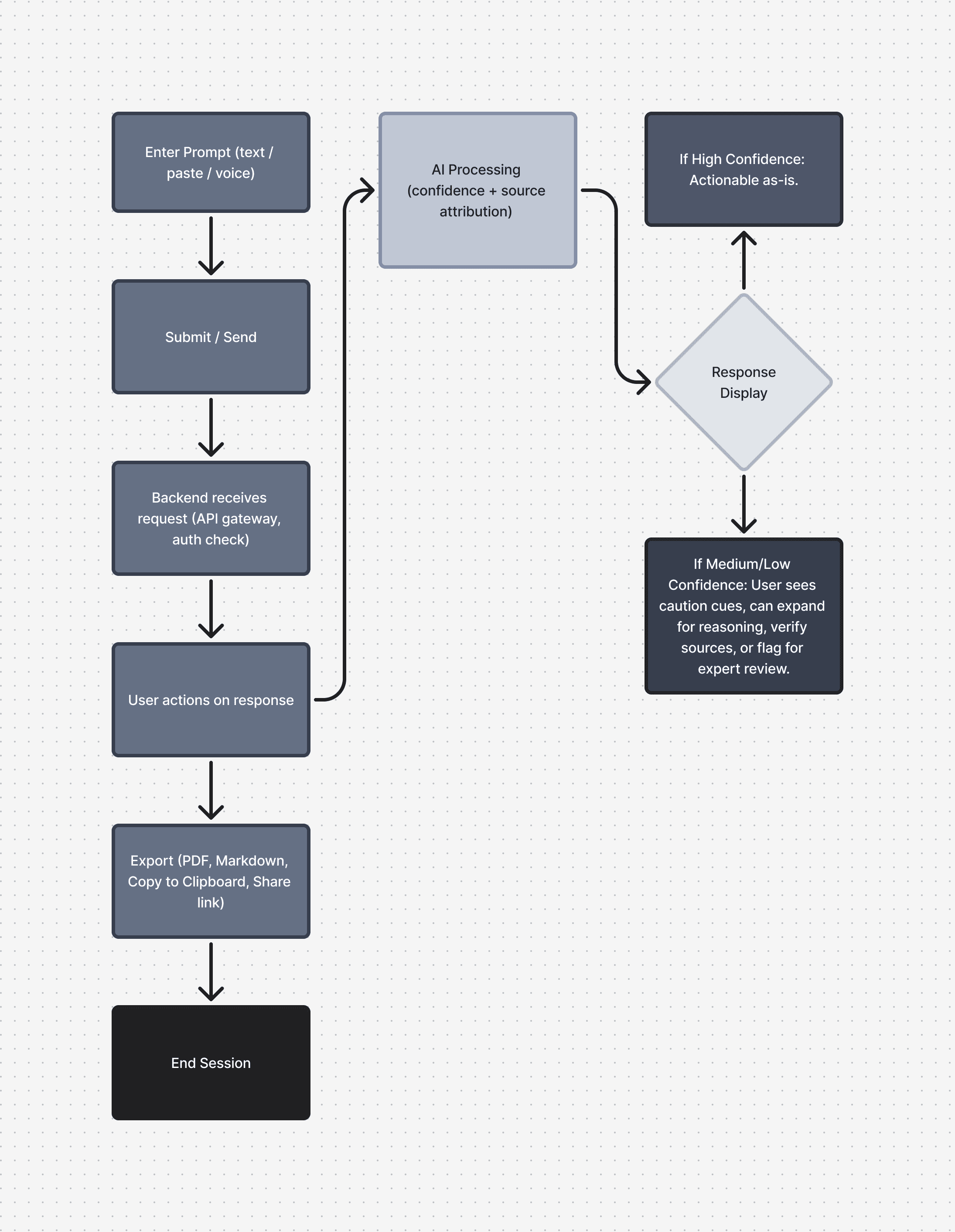
These wireframes will display clear, color-coded confidence indicators for every AI output. Transparency options, such as “How was this calculated?”, will always be accessible but unobtrusive. Trust tools will surface based on user actions, and verification options—including quick access to sources and expert help—will be seamless.
These wireframes will display clear, color-coded confidence indicators for every AI output. Transparency options, such as “How was this calculated?”, will always be accessible but unobtrusive. Trust tools will surface based on user actions, and verification options—including quick access to sources and expert help—will be seamless.
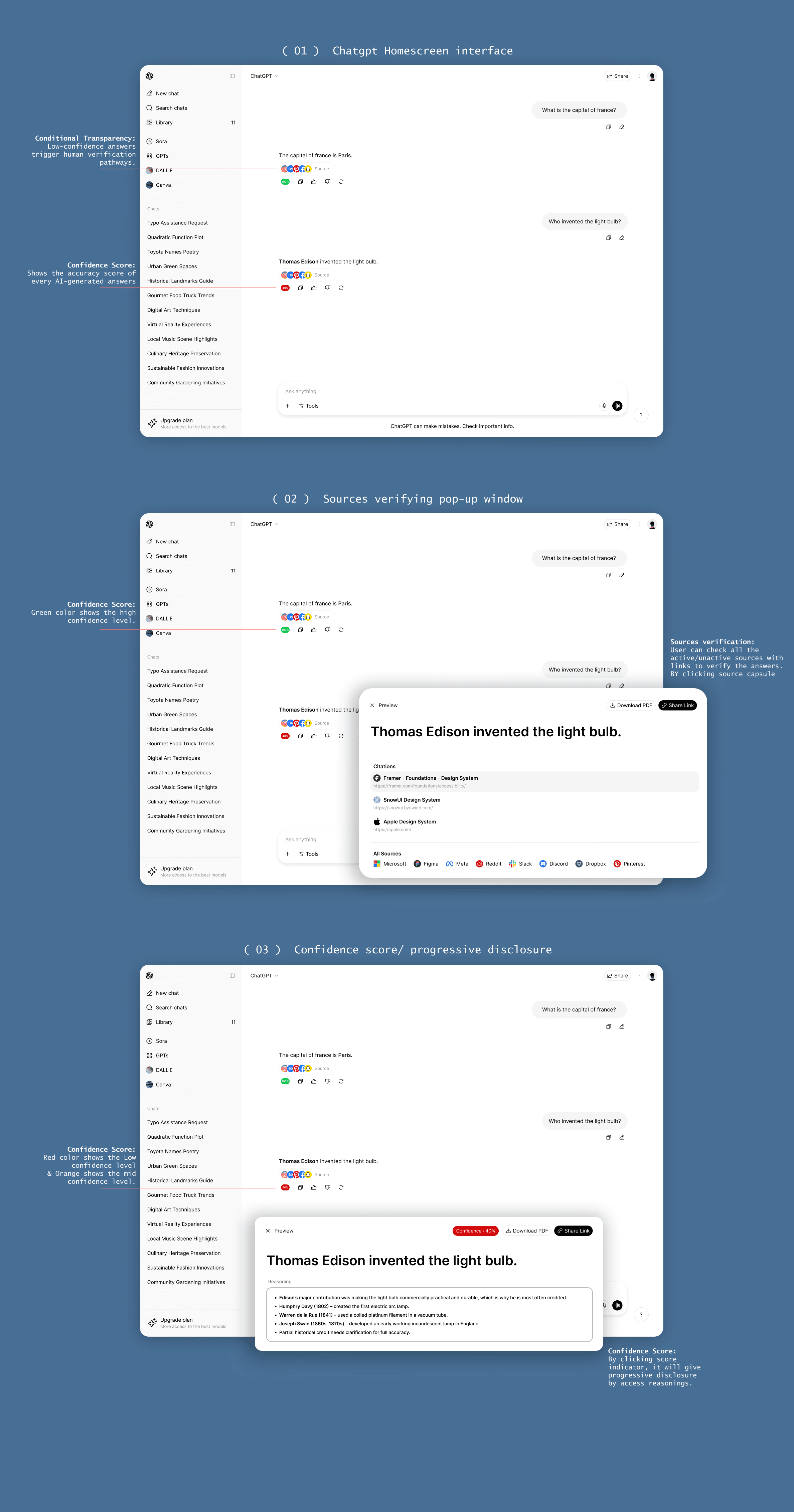
IMPACTS
IMPACTS
Increased User Trust and Confidence
Increased User Trust and Confidence
Clear visibility of AI confidence levels and reasoning helps users trust outputs and make informed decisions.
Clear visibility of AI confidence levels and reasoning helps users trust outputs and make informed decisions.
Reduced Errors and Operational Risk
Reduced Errors and Operational Risk
Warning cues and verification options prevent decisions based on uncertain or incorrect AI information, minimizing costly mistakes.
Warning cues and verification options prevent decisions based on uncertain or incorrect AI information, minimizing costly mistakes.
Improved Decision Efficiency
Improved Decision EfficiencY
Actionable high-confidence responses speed up workflows and reduce time spent on manual verification.
Actionable high-confidence responses speed up workflows and reduce time spent on manual verification.
TURNING DIGITAL CHAOS INTO CHEF'S KISS EXPERIENCES.
TURNING DIGITAL CHAOS INTO CHEF'S KISS EXPERIENCES.
LET'S WORK
TOGETHER
LET'S WORK
TOGETHER
LET'S WORK
TOGETHER
HIRE ME NOW